The Tunuba Learning Alliance grew from a bigger national effort to rethink how learning is recognised for First Nations young people, so that our children’s strengths, knowledges, responsibilities, and ways of being are seen, respected, and nurtured.
“It’s about students finishing and feeling like they’ve achieved something without having to sacrifice anything - without losing part of themselves”
The Problem
The colonial legacy of the education system continues to impact First Nations young people, families and communities. First Nations students report having to adapt, assimilate or give up parts of themselves in order to “succeed”.
Systems struggle to value and recognise the different intelligences, strengths and contributions to community that young people engage in to care for country and/or connect with and maintain their culture(s). The responsibility of local Traditional Owners to care for young people on country or enter into genuine equal partnerships with local communities remains a challenge for schools and school leaders.
Rather than placing significant value on the wellbeing and belonging of a young person, the system has focused on retention and attendance rates as markers of educational success.
These measures aren’t adequate to capture the whole First Nations young person - their wellbeing, or their learning ambitions.
Our Solution
Before recognition, there’s relationships.
Indigenous Nation-Led Learning Charters are centered on building new and trusted relationships with secondary schools that monitor and value Indigenous perspectives of wellbeing and that recognise the importance of learning that connects young mob to their Country, Language and Culture.
First Nations young people deserve to see their whole selves valued and recognised by their community, and broader school systems. Indigenous-led Charters with schools aim to enable new ways of working with First Nations communities so that learner wellbeing is valued just as much as academic measures.
Indigenous cultural determinants of wellbeing are used to guide how we can recognise the whole Indigenous Learner, supporting learners to thrive, at school and beyond. This creates a shared goal of wellbeing for schools and Nations to collaboratively work towards.
Tunuba Learning Charter
The charter is a living agreement between the Tunuba Learning Alliance and the schools we walk alongside. It will grow and evolve as we learn together. The purpose of this charter is threefold.
To provide a common framework for building trusting relationships between the Tunuba Learning Alliance and schools, one grounded in mutual respect and open communication. This means every partnership begins from a place of understanding and trust.
To value and recognise wellbeing as a key contributor to a young person's sense of belonging and their learning journey. A child who feels safe, seen, and connected to culture and Country is a child who is ready to learn.
To mobilise a Community of Practice that brings schools, students, and Traditional Custodians together to test and innovate new ways of working. This gives everyone involved room to try new approaches, learn honestly from what does and does not work, and share new understandings so that every school and every young person benefits.
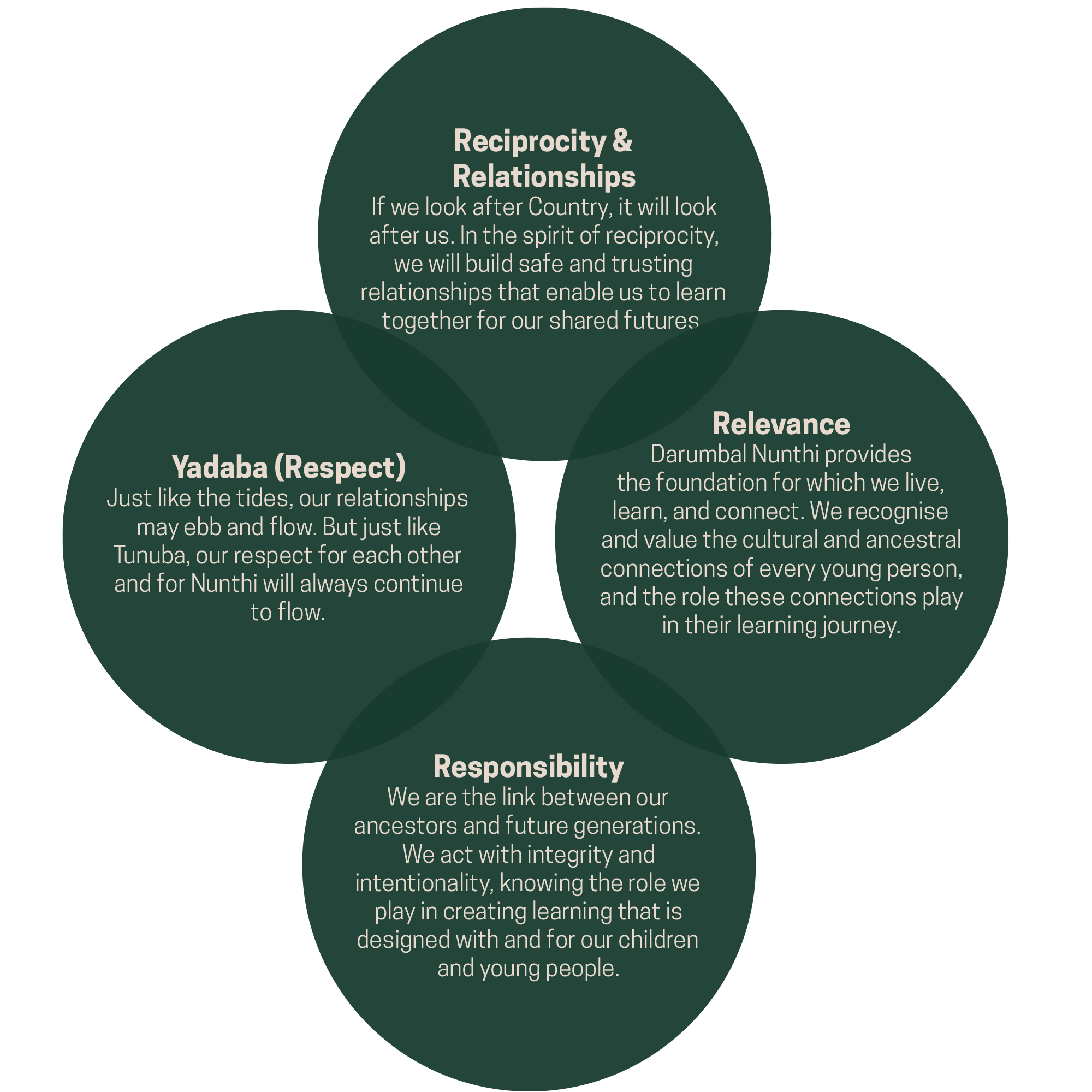
Shared Principles
Our Shared Principles guide how we will work together to deliver our vision and aspiration.
These principles have been adapted from the 5R’s of Indigenous pedagogy.
Supporting Our Learners
The LearningWell was developed by the National Indigenous Youth Education Coalition to support our work in recognising Aboriginal and Torres Strait Islander learner wellbeing.
The LearningWell is a student-driven recognition tool designed for Aboriginal and Torres Strait Islander high school students to value the deadly and diverse learning experiences they have both inside and outside of school.
Students are able to describe their learning experience in or outside of school, reflect on their experience using questions around respect, responsibility, relevance and relationships and connect their experience to the cultural determinants of wellbeing. The LearningWell has currently been piloted with students at North Rockhampton State High School and Rockhampton Flexible School.